Local Data Demonstrates What's Possible in School Aged Immunisations

In our previous blog post, we explored the critical findings of the Royal College of Paediatrics and Child Health (RCPCH) report, "Vaccination in the UK: Access, uptake and equity." We established that the decline in immunisation rates is driven less by parental hesitancy and more by systemic barriers to access and we discussed the immense potential that exists when schools and health services work together.
This week, we’ve been looking at the national coverage data, published by the UK Health Security Agency. While the national picture still shows a worrying dip in school-aged immunisation coverage, the local authority coverage data for our partners tells a different, more hopeful story. Dedicated school nursing teams and the 5–19 Healthy Child Programme workforce are proving what’s possible. When their expertise is supported with the right technology, designed around their workflows and service needs, they achieve extraordinary results in delivering accessible and equitable child healthcare.
Take Northumbria, a partner with us since 2022 their local team in Northumberland achieved an amazing 97.6% HPV coverage for Year 10 girls in 2023–24. Showing that when a well-organised team is backed by the right software, high coverage is possible even in the current climate.
Or look at Berkshire another long-standing customer. West Berkshire reached 94.1% coverage for Td/IPV and MenACWY (Year 10). Again, far above the national average and proof that when local teams are given the right systems to work with, uptake follows.

The RCPCH report highlights a key point: there is significant disparity in vaccine uptake in socioeconomically disadvantaged and ethnically diverse communities. While this national disparity is clear, we see immense promise in the data from our partners. When well-supported school-aged immunisation teams have access to software designed around their service needs, they are actively closing these gaps and ensuring high coverage across all communities.
Blackpool for example is regularly cited as one of the most disadvantaged areas in England, with high levels of child poverty and structural challenges that often correlate with lower vaccine uptake. Yet the school-aged immunisation team who we’ve supported with our software since 2021 exceeded the national average across multiple vaccines in 2023–24, including flu, HPV (Years 9 & 10), and Td/IPV + MenACWY. When Year 8 HPV uptake came in lower than expected, the team used real-time data to launch targeted catch-up clinics, reaching 79.3% HPV coverage for Year 10 girls a clear example of how visibility and flexibility translate into action, even in the hardest-to-reach communities.
In Slough one of the most ethnically diverse areas in the UK the local school-aged immunisation team achieved over 80% coverage for both Year 9 and Year 10 Td/IPV and MenACWY, with Year 10 Td/IPV reaching 85.6%. Their approach combines trusted relationships in schools with clear digital communication and easy parent access, removing barriers that can slow uptake.
These successes are not isolated. Supported by tailored digital systems, local teams are proving that high vaccination coverage is achievable regardless of socioeconomic background.
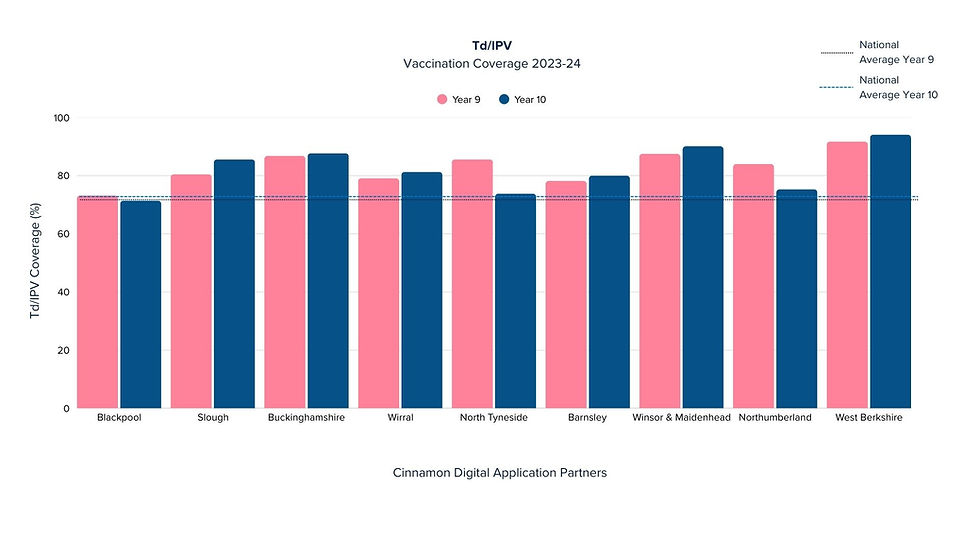
For example, Buckinghamshire, our very first partner and one of England's most affluent areas, the local team consistently achieves high immunisation coverage, often exceeding 87%. But equally impressive are the results from local authorities like Wirral and North Tyneside, whose coverage rates consistently mirror the performance of more affluent areas. Wirral’s team, for example, achieved an outstanding 89.8% for HPV Year 10 coverage, outperforming even Buckinghamshire, while North Tyneside reached an incredible 92.9% coverage for Year 9 female HPV and consistently maintains over 80% coverage on all other vaccines.
Barnsley is a striking example. Despite facing greater socioeconomic challenges, their school-aged immunisation team is now achieving coverage comparable to affluent areas like Windsor and Maidenhead. In 2023–24, Year 10 girls’ HPV uptake reached 84.2%, and Td/IPV and MenACWY coverage consistently topped 80%. Barnsley isn’t just catching up they’re showing how a committed team, with the right tools, can lead the way.

Across all our school-aged immunisation partners, 74% are outperforming the national average and those that aren’t yet there, almost all are improving year on year. None of this is accidental. it reflects the skill of local teams who understand their communities supported by technology designed to strengthen their work.
Our role has been to work alongside these teams to co-develop tools that:
Reduce admin and close data gaps through automatic NHS Number Tracing, validations, and integration with NHS systems
Simplify communication with digital consent forms and vaccine information delivered at the time of consent eliminating lost letters and confusion.
Streamline session management offering full control over clinic creation, schedules, stock, and staffing.
Support safety and clinic flow with digital triage and auditable notes for real-time collaboration.
Enable catch-up flexibility through automated reminders, rescheduling tools, and a 24/7 parent booking portal.
These are practical solutions to the very problems the RCPCH report outlines. they work because they’re built in partnership with the teams delivering the service.
The RCPCH report is clear and urgent. But alongside its warnings, it offers a way forward: invest in outreach, fund school nursing, strengthen immunisation teams, fix the data, build trust, and bring services to where people are . Because when teams are funded and supported uptake rises, when services are designed around families’ real lives access barriers fall and when technology complements workforce expertise impact is multiplied.
From our work with school-aged immunisation teams across the country, we believe the blueprint is already in action and it’s working. Not just in high-income areas like Buckinghamshire, but in places like Blackpool, Barnsley, North Tyneside, and Northumberland, where teams are delivering results against the odds.
So let’s build on what’s working. Let’s learn from the the local successes, better support our teams, design for inclusion and keep sharing insight. Because the more we understand what’s working locally, the more we can replicate that success nationally.
You can view the full national coverage statistics here


